
You enter your height into an ideal weight calculator, and instead of one clear answer, you get four or five different numbers. The Robinson formula says 127 pounds. The Devine formula says 132 pounds. The Miller formula says 119 pounds. Which one is correct?
This confusion is frustrating, but there is a good reason these formulas disagree. Each was developed at a different time, for a different purpose, using different population data. Understanding the history and methodology behind each formula helps you interpret the results correctly and choose the most relevant target for your body.
The Four Major Ideal Weight Formulas
Four formulas dominate ideal weight calculations. Here is each one broken down with its history, formula, and best use case.
1. The Devine Formula (1974)
History
Dr. B.J. Devine created this formula in 1974 specifically for calculating medication dosages, not for setting weight loss goals. Pharmaceutical companies needed a quick way to estimate lean body mass for drugs that distribute through muscle tissue rather than fat.
The Formula (Women)
Ideal Weight = 45.5 kg + 2.3 kg for each inch over 5 feet
Example (5'5" Woman)
45.5 + (5 x 2.3) = 45.5 + 11.5 = 57 kg = 126 lbs
Pros and Cons
- Pro: Still widely used in hospitals for medication dosing
- Pro: Simple calculation
- Con: Based on limited data from the 1970s
- Con: Tends to overestimate ideal weight for shorter women
- Con: Not designed for weight management
2. The Robinson Formula (1983)
History
Dr. J.D. Robinson modified the Devine formula in 1983 to better reflect actual clinical observations. This modification is now considered the gold standard for ideal body weight calculations in medical settings.
The Formula (Women)
Ideal Weight = 49 kg + 1.7 kg for each inch over 5 feet
Example (5'5" Woman)
49 + (5 x 1.7) = 49 + 8.5 = 57.5 kg = 127 lbs
Pros and Cons
- Pro: Most widely accepted formula in clinical practice
- Pro: Validated against actual health outcomes
- Pro: Good balance between conservative and aggressive estimates
- Con: Still based on older data
- Con: Does not account for body frame size
3. The Miller Formula (1983)
History
Dr. D.R. Miller developed this formula in 1983, also as a modification of the Devine formula. Miller's version produces lower ideal weight estimates, which some argue better reflects modern understanding of healthy weight.
The Formula (Women)
Ideal Weight = 53.1 kg + 1.36 kg for each inch over 5 feet
Example (5'5" Woman)
53.1 + (5 x 1.36) = 53.1 + 6.8 = 59.9 kg = 132 lbs
Wait - Miller actually gives a higher result for shorter women but lower for taller women. Let me recalculate:
Actually, the Miller formula for women is:
Ideal Weight = 53.1 kg + 1.36 kg for each inch over 5 feet
For a 5'5" woman: 53.1 + (5 x 1.36) = 53.1 + 6.8 = 59.9 kg = 132 lbs
Pros and Cons
- Pro: May be more appropriate for smaller-framed individuals
- Pro: Produces more conservative estimates for taller women
- Con: Can suggest unrealistically low weights for some body types
- Con: Less commonly used in clinical settings
4. The Hamwi Formula (1964)
History
Dr. G.J. Hamwi created this formula in 1964, making it the oldest of the four. It was designed specifically for nutritional assessment and meal planning, which is why dietitians still commonly use it today.
The Formula (Women)
Ideal Weight = 100 lbs for the first 5 feet + 5 lbs for each additional inch
Example (5'5" Woman)
100 + (5 x 5) = 100 + 25 = 125 lbs
Pros and Cons
- Pro: Easy to calculate without a calculator
- Pro: Includes frame size adjustments (add 10% for large frame, subtract 10% for small frame)
- Pro: Widely used by dietitians
- Con: Oldest formula with most dated data
- Con: May underestimate ideal weight for shorter women
Comparison: How the Formulas Differ by Height
Here is how each formula calculates ideal weight for women at different heights. Notice how the differences become more pronounced as height increases or decreases from the average.
| Height | Devine | Robinson | Miller | Hamwi |
|---|---|---|---|---|
| 5'0" | 100 lbs | 108 lbs | 117 lbs | 100 lbs |
| 5'2" | 110 lbs | 115 lbs | 123 lbs | 110 lbs |
| 5'4" | 120 lbs | 122 lbs | 129 lbs | 120 lbs |
| 5'6" | 130 lbs | 130 lbs | 135 lbs | 130 lbs |
| 5'8" | 140 lbs | 137 lbs | 141 lbs | 140 lbs |
| 5'10" | 150 lbs | 144 lbs | 147 lbs | 150 lbs |
| 6'0" | 160 lbs | 152 lbs | 153 lbs | 160 lbs |
Key observations:
- Formulas agree most closely around average height (5'4" to 5'6")
- For shorter women, Robinson and Miller tend to give higher estimates than Devine and Hamwi
- For taller women, Robinson gives the lowest estimates
- The range between highest and lowest formula can exceed 15 pounds
Which Formula Should You Use?
Rather than choosing a single formula, consider these guidelines:
For General Health Goals
Use the Robinson formula as your primary reference. It is the most widely validated and is considered the clinical standard. Our Ideal Weight Calculator displays Robinson results prominently for this reason.
For Shorter Women (Under 5'4")
The Miller formula or BMI-based range may be more appropriate. Traditional formulas can underestimate healthy weight for shorter women, sometimes suggesting weights that would put BMI below 18.5 (underweight).
For Taller Women (Over 5'8")
The Robinson formula tends to give the most reasonable estimates. Devine and Hamwi can suggest weights that are higher than necessary for optimal health in taller women.
For Nutrition Planning
Dietitians often use the Hamwi formula because it includes simple frame size adjustments. Add 10% for large frame, subtract 10% for small frame.
When in Doubt
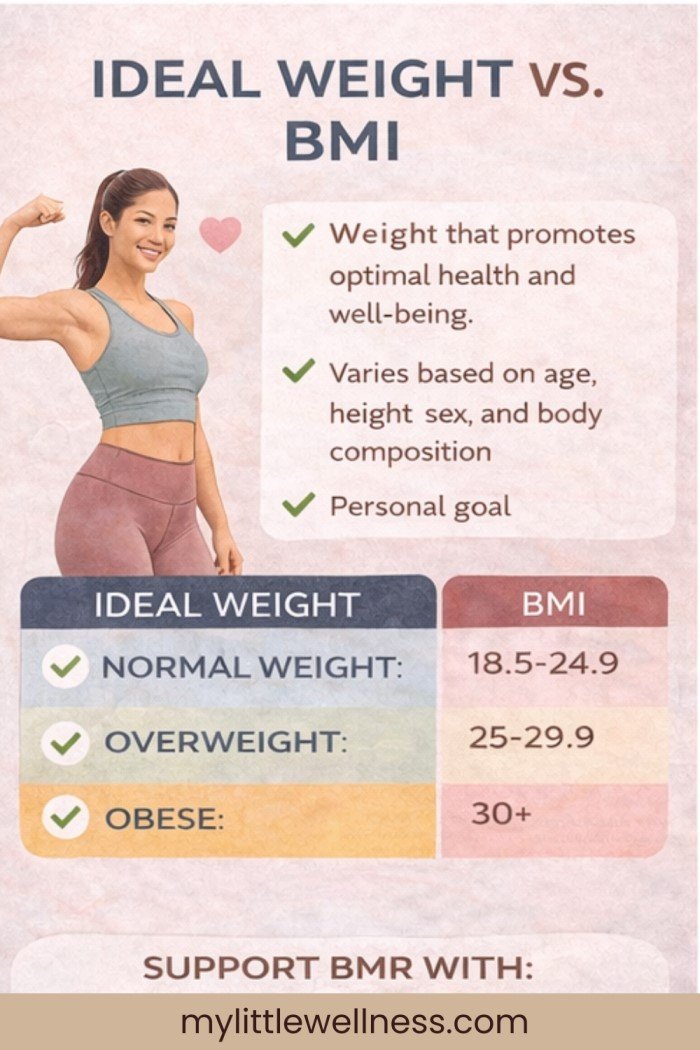
Calculate all four formulas and consider the range they produce. If formulas suggest 120-135 lbs for your height, any weight within that range is likely healthy. Combine this with a BMI check to verify your target falls within 18.5-24.9.
The BMI-Based Alternative
Instead of using height-based formulas, you can work backward from BMI to find a healthy weight range:
Healthy Weight Range = Height² (in meters) x 18.5 to 24.9
For a 5'5" (1.65m) woman:
- Lower bound: 1.65² x 18.5 = 50.4 kg = 111 lbs
- Upper bound: 1.65² x 24.9 = 67.8 kg = 149 lbs
This gives a healthy range of 111-149 lbs - much wider than any single formula, but perhaps more realistic about the range of healthy weights for any given height.
Why No Formula Is Perfect
All ideal weight formulas share fundamental limitations:
- They ignore body composition: Muscle weighs more than fat, so a fit, muscular woman may weigh "more" than her ideal while being perfectly healthy
- They assume medium frame: Large-boned individuals naturally weigh more; small-framed individuals weigh less
- They are based on old data: Population averages and health norms have changed since the 1960s-1980s
- They do not consider ethnicity: Different ethnic groups have different healthy weight distributions
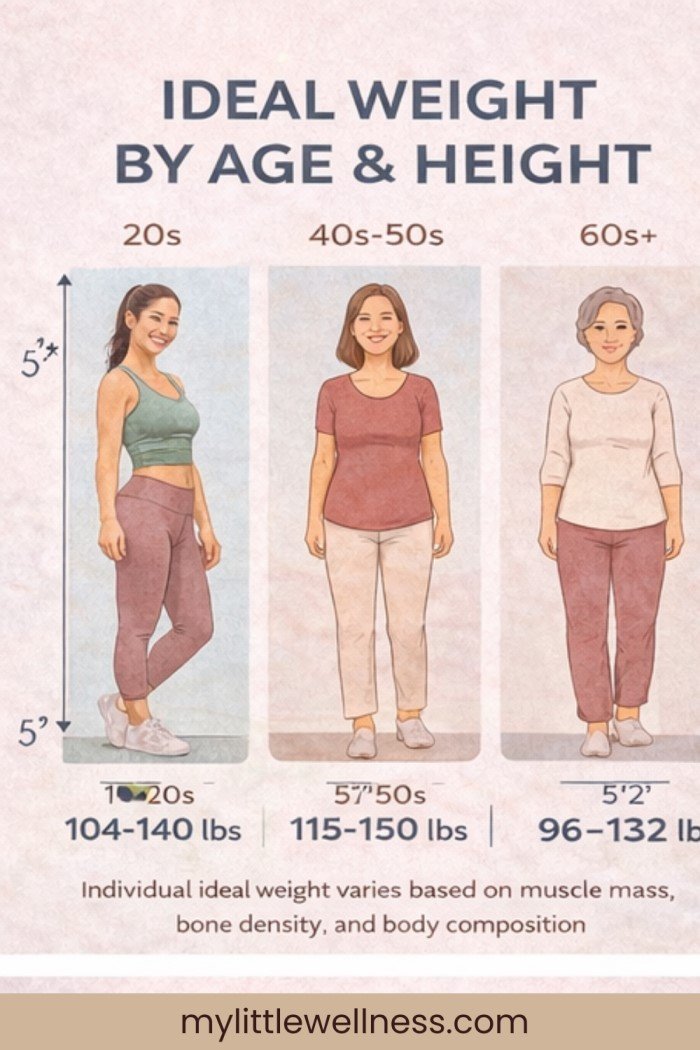
- They ignore age: Research suggests slightly higher weights may be protective in older adults
Read more about all the factors that affect your ideal weight beyond what formulas can capture.
Practical Recommendations
- Calculate multiple formulas: Use our Ideal Weight Calculator to see all results at once
- Identify the range: Note the lowest and highest results - your healthy weight likely falls somewhere between
- Verify with BMI: Ensure your target weight gives a BMI between 18.5-24.9
- Adjust for frame: If you have a large frame, aim for the higher end; small frame, the lower end
- Consider body composition: If you strength train, accept that you may healthily exceed formula predictions
- Focus on health markers: Blood pressure, blood sugar, cholesterol, and energy levels matter more than matching a formula
Disclaimer: This article is for informational purposes only and does not constitute medical advice. Ideal weight varies by individual. Consult a healthcare professional for personalised guidance.
Frequently Asked Questions
Which ideal weight formula is the most accurate?
The Robinson formula is considered most accurate for general use and is the standard in clinical settings today. However, for shorter women, BMI-based calculations may be more appropriate. The best approach is to use multiple formulas and consider the range they produce.
Why do I get different ideal weights from different calculators?
Different calculators use different formulas developed at different times for different purposes. The Devine formula was made for medication dosing, Hamwi for nutrition, and Robinson for clinical assessment. They each weight factors like height differently, producing varying results.
Should I aim for the lowest ideal weight formula result?
No. The lowest result is not necessarily the healthiest target. If the lowest formula puts your BMI below 18.5, it is too low. Consider all formula results as a range, and aim for somewhere in the middle that corresponds to a healthy BMI of 19-23.
Do ideal weight formulas work for all body types?
No. Standard formulas assume a medium body frame and do not account for muscle mass, bone density, or ethnic variations. Athletes, larger-framed women, and certain ethnic groups may have healthy weights that differ from formula predictions.
Are ideal weight formulas outdated?
Many formulas are decades old and were based on limited populations. While still useful as general guidelines, they should be combined with other metrics like BMI, waist circumference, and body fat percentage for a complete health picture.