Quick answer for parents
If you are comparing a nebulizer vs humidifier for babies, the simplest answer is this: a humidifier adds moisture to the room and is often enough for mild nasal congestion, while a nebulizer is for targeted saline or medication delivery when a doctor wants treatment to reach the airways. One is for room air support. The other is for active respiratory treatment.
If your baby sounds stuffy, wheezy, or uncomfortable at night, it is easy to wonder whether you need a humidifier, a nebulizer, or both. Parents often hear these tools mentioned together, but they do very different jobs.
The short answer is simple: a humidifier supports the room air, while a nebulizer delivers a targeted mist directly to your baby. This guide explains when each one makes sense, which warning signs call for a pediatrician, and how the two devices are sometimes used in the same care plan.
At a Glance: Nebulizer vs. Humidifier
| Feature | Humidifier | Nebulizer |
|---|---|---|
| Primary Goal | Prevention & Maintenance | Targeted Treatment |
| Where It Acts | The whole room (Ambient) | Directly in the Lungs |
| Usage | Continuous (Overnight) | Short sessions (10-15 mins) |
| Medication? | NO (Water only) | YES (Saline or Meds) |
| Prescription | Not needed | Required for medication |
What is a Humidifier? (The Ambient Helper)
A humidifier is a device that increases the humidity (moisture) in a specific room. For babies, the American Academy of Pediatrics almost always recommends cool-mist humidifiers. These turn water into a fine mist that disperses through the air.
When to use a Humidifier:
- Dry Air Prevention: If you live in a dry climate or run the heater/AC frequently.
- Minor Stuffy Nose: To keep nasal passages from drying out and cracking.
- Cough Relief: To soothe a dry, ticklish throat.
Think of a humidifier as environmental support. It doesn't "cure" a cold, but it makes the environment much easier for a congested baby to inhabit.
What is a Nebulizer? (The Targeted Treatment)
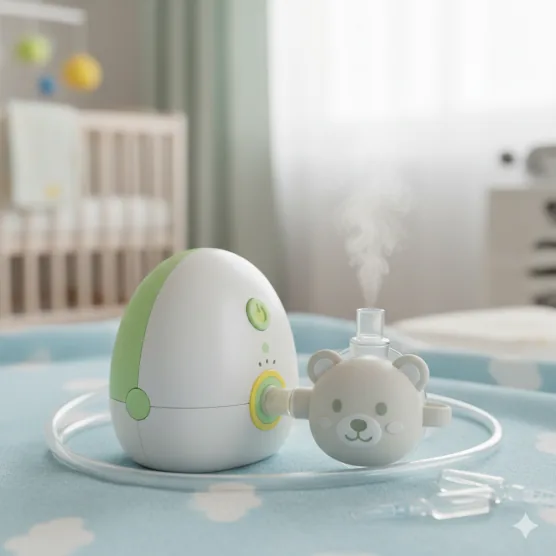
A nebulizer is a medical machine that turns liquid medication (or simple saline) into a very fine mist that is inhaled through a mask, as described by HealthyChildren.org. Unlike a humidifier, which fills a room, a nebulizer works via a mask held directly over the baby's nose and mouth.
When to use a Nebulizer:
- Chest Congestion: When the mucus is deep in the lungs.
- Wheezing/RSV: To deliver bronchodilators that open up small airways.
- Acute illness: When prescribed by a doctor to treat a specific respiratory infection.
A nebulizer is a medical intervention. It delivers particles small enough to travel deep into the lower respiratory tract, whereas humidifier droplets are usually too large to reach that deep.
Key Differences Parents Should Know
1. Particle Size Matters
Humidifiers produce larger water droplets that mostly land in the upper nose and throat. Nebulizers produce "nebulized" particles (microns in size) that can bypass the upper airway and deposit directly in the bronchioles.
2. Hygiene and Cleaning
Both devices require strict hygiene, but a dirty nebulizer is significantly more dangerous. Since a nebulizer delivers mist directly into the lungs, any mold or bacteria in the machine will be "injected" directly into your baby's system. Learn more about nebulizer safety.
3. Safety with Additives
Never put essential oils or Vicks in a nebulizer. Similarly, pediatricians advise against putting oils in humidifiers for babies under 2 years old, as it can irritate their sensitive lung tissue.
Which One Does Your Baby Need Right Now?
Use a Humidifier if...
- Your baby has a "dry" sounding cough.
- The skin inside their nose looks dry or has crusty mucus.
- It's winter and your home air feels static-heavy.
- You want to support overall sleep quality during a mild cold.
Consult a Doctor for a Nebulizer if...
- You see "retractions" (skin pulling in between ribs when breathing).
- Your baby is wheezing or making whistling sounds.
- The congestion is preventing them from feeding or drinking.
- They have been diagnosed with RSV or Bronchiolitis.
Warning Signs That Mean You Should Seek Help
If your baby is breathing faster than usual, struggling to feed, or looks tired while breathing, it is time to stop guessing and get medical guidance. A humidifier can make a room more comfortable, but it cannot treat breathing distress.
- Skin pulling in between the ribs, at the throat, or under the rib cage
- Wheezing, grunting, or pauses in breathing
- Blue lips, poor feeding, or fewer wet diapers
- Symptoms getting worse instead of better after several days
Use our guides on when to take a baby to the doctor for chest congestion and normal vs abnormal baby breathing patterns if you need help deciding what is urgent.
Cool Mist vs Warm Mist: Which Humidifier Type is Best for Babies?
The American Academy of Pediatrics recommends cool-mist humidifiers for homes with infants. Warm-mist models heat water to create steam, which poses a serious burn risk if the unit tips over near a crib or play area.
Both types add the same amount of moisture to room air. The key difference is safety, not effectiveness. If you already own a warm-mist model, place it well out of reach and consider switching to cool-mist before your baby becomes mobile.
Cost Comparison: Nebulizer vs Humidifier
| Item | Humidifier | Nebulizer |
|---|---|---|
| Device Cost | $20 – $50 | $30 – $80 |
| Ongoing Supplies | Distilled water, filters ($5-$10/month) | Masks, tubing, saline ($10-$20/month) |
| Prescription Needed? | No | Yes (for medication) |
| Insurance Coverage | Rarely | Often covered when prescribed |
What Can You Put in a Nebulizer for Baby Congestion?
Only use what your pediatrician prescribes. Common nebulizer solutions for infants include:
- Normal saline (0.9%): The safest option. Loosens mucus and moisturizes airways without medication.
- Hypertonic saline (3%): Prescription-strength saline that draws water into airways to thin thick mucus.
- Albuterol (Salbutamol): A bronchodilator prescribed for wheezing, asthma, or reactive airway disease.
- Ipratropium bromide: Sometimes combined with albuterol for more severe bronchospasm.
Never put essential oils, Vicks VapoRub, honey, herbal mixtures, or any home remedy into a nebulizer. These can cause serious lung irritation or chemical pneumonitis in babies. Learn more about safe nebulizer medicines for infants.
How Long to Run a Nebulizer for Your Baby
A typical nebulizer session lasts 10 to 15 minutes. The session naturally ends when the medicine cup is empty and no more mist comes out. For babies, keep these tips in mind:
- Hold the mask gently but firmly over nose and mouth  gaps reduce effectiveness.
- Keep baby upright or slightly reclined (not lying flat).
- If your baby cries, that's actually okay  crying creates deep breaths that pull the mist deeper into the lungs.
- Follow your doctor's schedule. Most prescriptions call for sessions every 4-6 hours during acute illness.
For more tips on keeping your baby calm, read our complete nebulizer guide for parents.
Can You Use a Nebulizer and Humidifier Together?
Yes  in fact, many pediatricians recommend using both as part of a combined care plan:
- Step 1: Run a prescribed nebulizer session (10-15 min) to deliver saline or medication directly to the lungs.
- Step 2: After the session, suction out loosened mucus with a bulb syringe or NoseFrida.
- Step 3: Run a cool-mist humidifier in the nursery overnight to prevent the remaining mucus from thickening.
This approach tackles congestion from both angles: active treatment (nebulizer) and passive prevention (humidifier).
Cleaning and Maintenance: Both Devices Need It
Dirty devices can harbor mold, bacteria, and mineral deposits that worsen respiratory symptoms. Follow these cleaning schedules:
Humidifier Cleaning
- Daily: Empty remaining water, rinse with clean water, air dry.
- Weekly: Disinfect with white vinegar or diluted hydrogen peroxide.
- Monthly: Replace filters (if applicable).
- Use distilled water to prevent mineral buildup ("white dust").
Nebulizer Cleaning
- After every use: Disassemble mask, cup, and tubing. Wash with warm soapy water. Rinse and air dry on a clean towel.
- Weekly: Soak parts in a vinegar-water solution (1:3 ratio) for 30 minutes.
- Replace: Masks and tubing every 3-6 months or when discolored.
For a detailed step-by-step cleaning guide, see our post on how to clean a baby nebulizer properly.
Conclusion: A Winning Combination
Often, the best strategy for a congested baby is a combination of both. You might use a 10-minute nebulizer session with saline (as directed by a doctor) to loosen deep mucus, followed by running a cool-mist humidifier in the nursery to keep that mucus from thickening up again overnight.
Always remember: When in doubt, call your pediatrician. Breathing issues in infants can change rapidly, and expert guidance is always the safest route.
For a complete overview of nebulizer safety, medicines, and age guidelines, read our complete nebulizer guide for infants & babies.
Quick Decision Tree for Parents
- If symptoms are mild dryness or stuffy nose: start with humidifier + saline care.
- If wheeze, chest pull, or feeding difficulty appears: call pediatrician the same day.
- If distress signs are severe: seek urgent emergency care.
How to Use Both Devices in One Care Plan
For some babies, the plan is sequential. A doctor-directed nebulizer session can target lower-airway symptoms, while a cool-mist humidifier helps maintain airway moisture between sessions and overnight.
Common Parent Errors to Avoid
- Using medication in a nebulizer without doctor direction.
- Skipping daily cleaning and drying protocol.
- Delaying care when breathing effort is clearly increasing.
- Using a warm-mist humidifier near a baby's crib (burn risk).
- Adding essential oils or Vicks to either device for babies under 2.
- Not replacing nebulizer masks and tubing every 3-6 months.
Frequently Asked Questions
Can I use a humidifier instead of a nebulizer for my baby?
No, they serve different purposes. A humidifier adds moisture to the entire room to prevent nasal dryness, while a nebulizer delivers targeted saline or medication directly into the lungs to treat specific respiratory issues.
Which is better for a stuffy nose  nebulizer or humidifier?
For general stuffy nose relief and prevention, a cool-mist humidifier is usually enough. However, if the congestion is chest-related or accompanied by wheezing, a pediatrician might recommend a nebulizer session.
Is it safe to run a humidifier all night for a baby?
Yes, a cool-mist humidifier is safe to run all night, provided it is kept clean and positioned at least 3-4 feet away from the crib to avoid over-saturating the bedding.
Can you use a nebulizer and humidifier at the same time?
Yes, you can use both in the same care plan. Use the nebulizer for targeted 10-15 minute treatment sessions as prescribed by your doctor, and run the humidifier in the room between sessions and overnight to maintain moisture levels.
Is cool mist or warm mist humidifier better for baby congestion?
Cool-mist humidifiers are recommended by the American Academy of Pediatrics for babies. Warm-mist humidifiers pose a burn risk if knocked over. Both add the same amount of moisture to the air, but cool-mist is safer for infants and toddlers.
How long should I run a nebulizer for my baby?
A typical nebulizer session for babies lasts 10 to 15 minutes. The session ends when the medicine cup is empty and no more mist is produced. Always follow your pediatrician's instructions for frequency and duration.
What can I put in a nebulizer for baby congestion?
Only use normal saline (0.9% sodium chloride) or doctor-prescribed medication in a nebulizer. Never add essential oils, Vicks, or home remedies. Saline helps loosen mucus, while prescribed bronchodilators open airways for conditions like wheezing or RSV.
How much does a nebulizer cost compared to a humidifier?
A basic cool-mist humidifier costs $20-$50 and requires only distilled water. A home nebulizer machine costs $30-$80, but also requires nebulizer masks ($5-$15), saline solution, and potentially prescription medication. Insurance often covers nebulizers when prescribed.