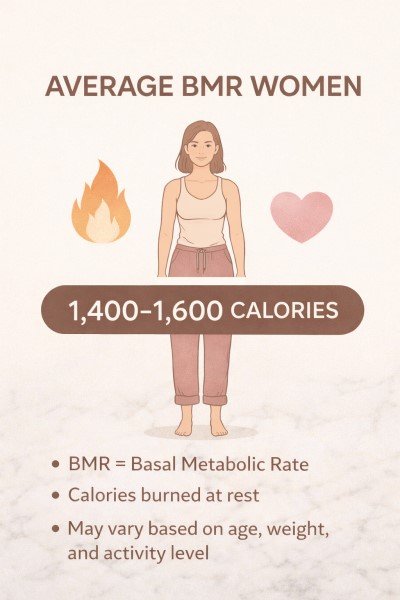
Your Basal Metabolic Rate, or BMR, is the number of calories your body burns just to stay alive. Think of it as the energy cost of breathing, pumping blood, maintaining body temperature, and keeping your organs functioning while you do absolutely nothing. For most women, this number falls somewhere between 1,200 and 1,500 calories per day, but it varies widely depending on your age, height, weight, and body composition. If you want a quick personal estimate, try our BMR calculator right now.
Understanding your average BMR is one of the smartest things you can do for your nutrition and health. It gives you a science-based starting point for figuring out how many calories you actually need, whether your goal is weight loss, maintenance, or building strength. Instead of guessing or following a one-size-fits-all calorie number, knowing your BMR lets you make informed, personalized decisions about what and how much to eat.
What Is BMR and Why Does It Matter?
BMR stands for Basal Metabolic Rate. It represents the minimum number of calories your body requires to perform its most basic life-sustaining functions while at complete rest. This includes powering your brain, circulating blood through your heart and vessels, breathing, repairing cells, regulating hormones, and maintaining your body temperature. Even if you spent the entire day lying in bed without moving, your body would still burn this many calories just to keep you alive.
For women, understanding BMR is especially valuable. Female metabolism is influenced by hormonal fluctuations throughout the menstrual cycle, pregnancy, and menopause. Women also tend to have less muscle mass than men, which directly affects metabolic rate. Knowing your BMR can help you avoid the common trap of eating too few calories, which can slow your metabolism further and make weight management harder over time. It also helps you set realistic calorie targets that support your energy, mood, and long-term health rather than working against them.
Average BMR for Women by Age
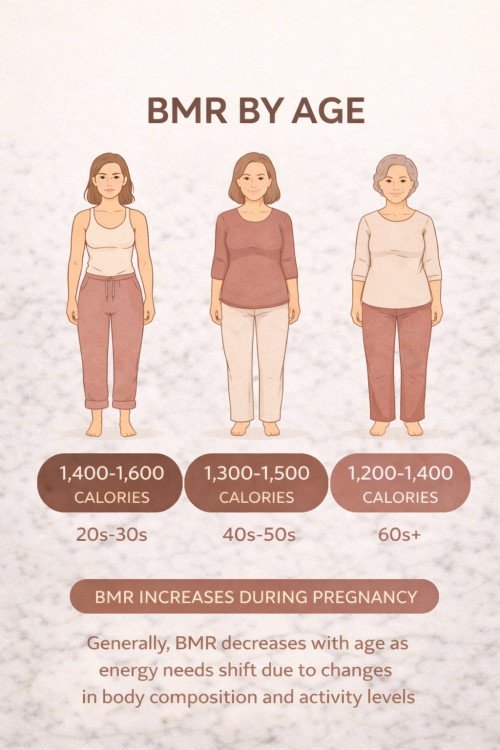
Your BMR changes as you age. Metabolism is generally highest in your late teens and early twenties, then gradually declines over the decades. The table below shows typical BMR ranges for women at different life stages. These estimates are based on average-height women (5'4" to 5'5") at a healthy weight.
| Age Range | Average BMR (cal/day) | Notes |
|---|---|---|
| 18-25 | 1,350-1,550 | Peak metabolic years |
| 26-35 | 1,300-1,500 | Slight decline begins |
| 36-45 | 1,250-1,450 | Perimenopause may start |
| 46-55 | 1,200-1,400 | Menopause affects metabolism |
| 56-65 | 1,150-1,350 | Muscle preservation is key |
| 65+ | 1,100-1,300 | Stay active and eat enough protein |
Note: These ranges are based on average-height women (5'4" to 5'5") at a healthy weight. Your individual BMR may be higher or lower depending on your specific body composition and genetics. For a detailed look at how metabolism shifts across each decade, see our guide on BMR by age for women.
What Affects Your BMR?
Several factors determine where your BMR falls within the average range. Some you can control, and others you cannot. Understanding these factors helps you set realistic expectations and take action where it matters most.
- Muscle mass -- More muscle means a higher BMR. Muscle tissue burns more calories at rest than fat tissue, which is why strength training is so effective for boosting metabolism.
- Body size -- Taller and heavier women generally have higher BMRs because there is more tissue for the body to maintain.
- Age -- BMR decreases by roughly 1 to 2 percent per decade after age 20, largely because of gradual muscle loss.
- Hormones -- Thyroid hormones play a major role in metabolic rate. The menstrual cycle, pregnancy, and menopause also cause temporary and long-term metabolic shifts.
- Genetics -- Some women are genetically predisposed to a faster or slower metabolism. While you cannot change your genes, lifestyle factors can still make a meaningful difference.
- Sleep quality -- Poor sleep disrupts hormones that regulate metabolism, including cortisol and leptin. Consistently getting less than seven hours can lower your BMR over time.
For a deeper dive into the science behind metabolic factors, the National Institute of Diabetes and Digestive and Kidney Diseases provides an excellent overview of factors affecting weight and health.
BMR vs TDEE: Which Number Should You Use?
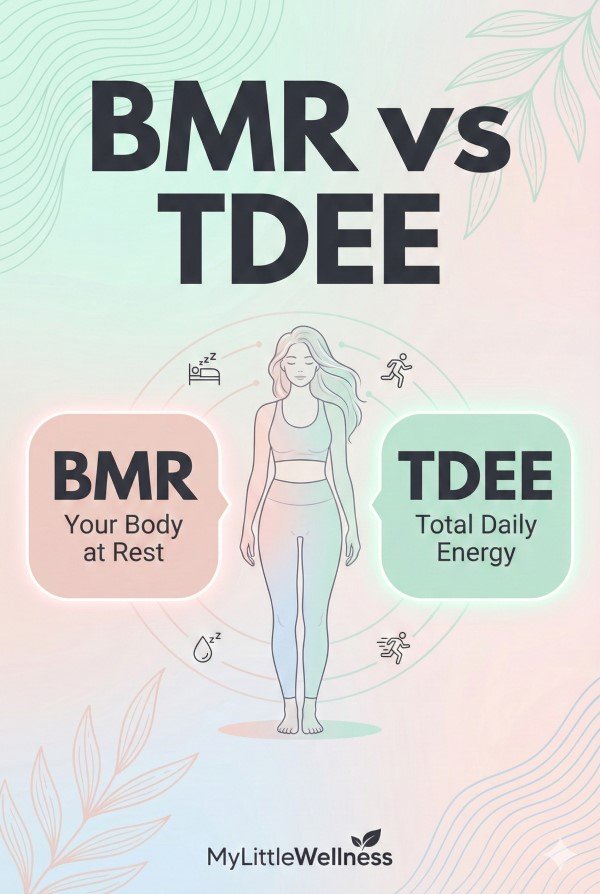
One of the most common mistakes people make is confusing BMR with the total number of calories they should eat. Your BMR is the energy your body needs at complete rest. Your Total Daily Energy Expenditure, or TDEE, is higher because it accounts for all the movement and activity in your day, from walking and exercising to simply digesting food.
For weight management, you should base your calorie goals on TDEE, not BMR. Eating at or below your BMR for extended periods can slow your metabolism, cause muscle loss, and leave you feeling exhausted and irritable. Instead, calculate your TDEE and create a modest deficit from there if weight loss is your goal. A safe starting point is 200 to 500 calories below your TDEE.
To understand the difference in more detail, read our full comparison of BMR vs TDEE explained. You can also use our BMI calculator to get a broader picture of where you stand health-wise alongside your metabolic numbers.
How to Calculate Your Exact BMR
The most widely accepted formula for estimating BMR is the Mifflin-St Jeor equation, which has been shown to be the most accurate for most people. For women, the formula is:
BMR = (10 x weight in kg) + (6.25 x height in cm) - (5 x age in years) - 161
Here is a quick example. A 35-year-old woman who weighs 150 pounds (68 kg) and is 5'5" (165 cm) tall would calculate her BMR as follows:
- (10 x 68) = 680
- (6.25 x 165) = 1,031.25
- (5 x 35) = 175
- 680 + 1,031.25 - 175 - 161 = 1,375.25 calories per day
So her estimated BMR is approximately 1,375 calories per day, which falls right in line with the average range for her age group.
If you do not want to do the math yourself, use our free BMR calculator for instant, personalized results. While you are at it, you might also find our ideal weight calculator and water intake calculator helpful for building a complete picture of your health goals.
Tips to Support a Healthy BMR
While you cannot completely control your metabolic rate, there are several evidence-based strategies that can help you maintain or even boost your BMR over time.
- Build muscle through strength training. Resistance exercise is the single most effective way to raise your resting metabolic rate. Aim for at least two to three sessions per week targeting all major muscle groups.
- Get 7 to 9 hours of sleep. Sleep deprivation lowers your metabolism and increases hunger hormones. Prioritize consistent, quality rest every night.
- Eat enough protein. Aim for 0.7 to 1 gram of protein per pound of body weight daily. Protein has a higher thermic effect than carbohydrates or fat, meaning your body burns more calories digesting it.
- Stay hydrated. Even mild dehydration can slow metabolic processes. Drink water consistently throughout the day.
- Avoid extreme calorie restriction. Crash diets and very low calorie intakes signal your body to conserve energy, which lowers your BMR. Instead, create a moderate calorie deficit and lose weight gradually.
What to Do Next
Now that you understand what the average BMR for women looks like and what factors influence it, here is how to put this knowledge into action.
- Calculate your BMR using our BMR calculator to get your personalized number in seconds.
- Explore related articles on metabolism, weight management, and nutrition to deepen your understanding.
- Remember that these are estimates. Individual results vary based on genetics, health conditions, and lifestyle. Use your BMR as a starting point, then track your progress over two to four weeks and adjust as needed.
The most important thing is to stop guessing and start making decisions based on your own numbers. Your body is unique, and your nutrition plan should reflect that.
Frequently Asked Questions
What is a normal BMR for a woman?
A normal BMR for a woman typically ranges from 1,200 to 1,500 calories per day. This depends on your age, height, weight, and body composition. Younger, taller, and more muscular women tend to have higher BMRs.
Is 1,200 BMR too low?
A BMR of 1,200 is on the lower end but not necessarily unhealthy. It is common in petite women, older adults, or those with less muscle mass. If your BMR is around 1,200, focus on nutrient-dense foods and strength training to support your metabolism.
Does BMR decrease with age?
Yes. BMR decreases roughly 1 to 2 percent per decade after age 20, mainly due to muscle loss. Regular strength training and adequate protein intake can help slow this decline.
How do I find my exact BMR?
Use a BMR calculator that applies the Mifflin-St Jeor equation. Enter your age, height, weight, and gender for a personalized estimate. For the most accuracy, track your results over two to four weeks and adjust.
Is BMR the same as the calories I should eat?
No. BMR is only the calories your body needs at complete rest. Your actual daily calorie needs (TDEE) are higher because they include movement, exercise, and digestion. Never eat below your BMR for extended periods.
Disclaimer: This article is for informational purposes only and does not constitute medical advice. Always consult a healthcare professional before making changes to your diet or exercise routine.