
If you have ever typed your stats into a BMR calculator and then seen a completely different number labelled TDEE, you are not alone. Many women starting their weight loss journey feel confused by these two acronyms. Both represent calorie numbers, both come from equations, and both claim to matter - so which one should you actually pay attention to?
The short answer is that both numbers matter, but only one should be used to set your daily calorie target. Understanding the difference between BMR and TDEE is the first step toward building an eating plan that helps you lose weight without wrecking your metabolism. Let's break it down.
What Is BMR?
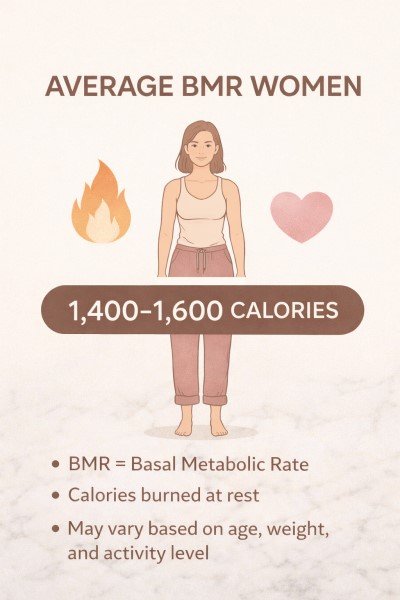
BMR stands for Basal Metabolic Rate. It is the minimum number of calories your body needs to perform its most basic life-sustaining functions while you are completely at rest. Think of BMR as the energy cost of simply being alive - no movement, no digestion, just your organs doing their jobs.
Your BMR powers critical processes including:
- Heartbeat and blood circulation
- Breathing and lung function
- Brain activity and nervous system operation
- Cell repair and regeneration
- Hormone production and regulation
The most widely accepted formula for calculating BMR is the Mifflin-St Jeor equation. For women it looks like this:
BMR = (10 x weight in kg) + (6.25 x height in cm) - (5 x age in years) - 161
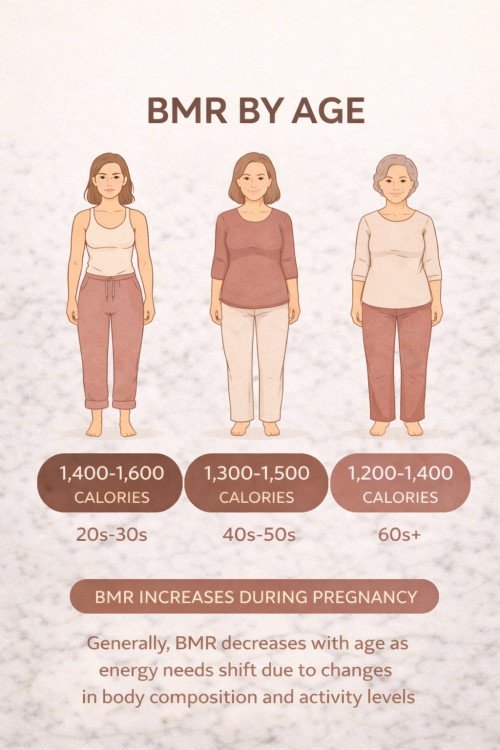
For most adult women, BMR falls somewhere between 1,200 and 1,500 calories per day, depending on age, height, and weight. You can see where you fall by checking the average BMR for women by age and weight.
What Is TDEE?
TDEE stands for Total Daily Energy Expenditure. It represents the total number of calories you burn in an entire day, combining your BMR with every other source of energy output. If BMR is the engine idling, TDEE is the engine running through a full day of driving.
TDEE is made up of three components:
- BMR (about 60-70% of total calories burned): Your baseline metabolic functions at rest
- Physical activity (about 20-30%): Everything from structured exercise to walking around the house, fidgeting, and doing chores
- Thermic effect of food (about 10%): The energy your body uses to digest, absorb, and process the food you eat
TDEE is the number that reflects what you actually burn in a whole day. It is always higher than BMR because it accounts for every movement and process beyond simply lying still.
BMR vs TDEE at a Glance
Here is a side-by-side comparison to make the differences clear:
| BMR | TDEE | |
|---|---|---|
| What it measures | Calories at complete rest | Total calories burned per day |
| Includes activity? | No | Yes |
| Use for eating plan? | No (too low) | Yes |
| Average for women | 1,200-1,500 cal | 1,600-2,200 cal |
| Changes daily? | Relatively stable | Varies with activity |
Which Number Should You Eat For?
This is the question that trips up so many women, and getting it wrong can stall your progress or even harm your health. The answer is straightforward: always base your calorie intake on TDEE, never on BMR alone.
Here is how to use TDEE for different goals:
- For weight loss: Eat TDEE minus 300-500 calories per day
- For maintenance: Eat at your TDEE
- For weight gain: Eat TDEE plus 200-300 calories per day
A moderate deficit of 300-500 calories below TDEE translates to roughly 0.5-1 pound of fat loss per week. This pace is sustainable, preserves muscle mass, and keeps your energy levels stable.
Warning: Never eat below your BMR for extended periods. Doing so can slow your metabolism, trigger muscle loss, cause hormonal disruptions, and lead to nutrient deficiencies. Your body interprets severe restriction as starvation and responds by conserving energy - the exact opposite of what you want.
Use our TDEE calculator to find your total daily energy expenditure, then use the calorie calculator to find your personalised target based on your weight goals. Once you know your calories, the macros calculator can help you split that into protein, carbs, and fat.
Activity Multipliers Explained
To convert your BMR into TDEE, you multiply it by an activity factor. Choosing the right multiplier is critical because picking the wrong one can throw your calorie target off by hundreds of calories.
| Activity Level | Multiplier | Example |
|---|---|---|
| Sedentary | BMR x 1.2 | Desk job, little exercise |
| Lightly Active | BMR x 1.375 | Walking, light exercise 1-3 days |
| Moderately Active | BMR x 1.55 | Exercise 3-5 days per week |
| Very Active | BMR x 1.725 | Hard exercise 6-7 days |
| Extremely Active | BMR x 1.9 | Athletes, physical labor |
Tip: Most people overestimate their activity level. If you are unsure, start with lightly active and adjust after two to three weeks based on your results. Overestimating leads to eating too many calories and wondering why weight loss stalls even though you think you are in a deficit.
A Real Example
Let's put the numbers to work with a real scenario. Meet Sarah:
- Age: 35 years old
- Weight: 160 lbs (73 kg)
- Height: 5'5" (165 cm)
- Activity: Moderately active (exercises 3-5 days per week)
Step 1 - Calculate BMR:
BMR = (10 x 73) + (6.25 x 165) - (5 x 35) - 161
BMR = 730 + 1,031.25 - 175 - 161 = approximately 1,406 calories
Step 2 - Calculate TDEE:
TDEE = 1,406 x 1.55 = approximately 2,179 calories
Step 3 - Set a weight loss target:
TDEE - 400 = 2,179 - 400 = approximately 1,779 calories per day
Here is the key insight: eating 1,779 calories a day is sustainable. Sarah still gets enough fuel to exercise, think clearly, and go about her daily life. If she tried to eat only her BMR of 1,406 calories while exercising regularly, she would be running on far too little fuel. She would feel exhausted, her workouts would suffer, and her body would eventually fight back by slowing her metabolism.
Common Mistakes Women Make
After helping thousands of women understand their calorie needs, these are the errors that come up again and again:
- Eating only BMR calories while exercising: This creates an excessively large calorie deficit that is not sustainable and can trigger metabolic slowdown
- Using TDEE from an overly active category: Selecting "very active" when you actually exercise three times a week leads to overeating without realising it
- Not adjusting as weight changes: As you lose weight, both your BMR and TDEE decrease. Recalculate every 5-10 pounds lost
- Ignoring NEAT: Non-exercise activity thermogenesis - the calories you burn through fidgeting, walking, standing, and doing household tasks - plays a bigger role than most people think
- Not drinking enough water: Proper hydration supports your metabolism and helps your body process food efficiently. Check how much you need with our water intake calculator
According to the Mayo Clinic, metabolism is influenced by body size, sex, and age, and while you cannot control all of these factors, you can optimise the ones within your reach through consistent exercise, adequate protein intake, and sufficient sleep.
What to Do Next
Now that you understand the difference between BMR and TDEE, here is how to put this knowledge into action:
- Calculate your numbers: Use our BMR calculator to get both your BMR and TDEE in one step
- Set your calorie target: Subtract 300-500 calories from your TDEE for safe, sustainable weight loss
- Check your overall health picture: Also look at your BMI and ideal weight to set realistic goals
- Track for two weeks: Follow your calorie target consistently and weigh yourself at the same time each day to see the trend
- Adjust as needed: If you are losing more than 1 pound per week, eat slightly more. If you are not losing, reduce by another 100 calories or increase activity
Disclaimer: This article is for informational purposes only and does not constitute medical advice. Consult a healthcare professional before making dietary changes.
Frequently Asked Questions
What is the difference between BMR and TDEE?
BMR is the calories your body burns at complete rest just to stay alive. TDEE is your total daily calorie burn including BMR plus all activity, exercise, and digestion. TDEE is always higher than BMR.
Should I eat my BMR or TDEE to lose weight?
You should eat below your TDEE, not your BMR. A safe approach is to subtract 300 to 500 calories from your TDEE. Eating below your BMR for extended periods can slow your metabolism and cause muscle loss.
How do I calculate my TDEE?
First calculate your BMR using the Mifflin-St Jeor equation, then multiply it by an activity factor: 1.2 for sedentary, 1.375 for lightly active, 1.55 for moderately active, 1.725 for very active, or 1.9 for extremely active.
Can TDEE change day to day?
Yes. Your TDEE fluctuates based on how much you move, your workout intensity, stress levels, sleep quality, and even the temperature. This is why using a weekly average is more practical than daily tracking.
Why is my TDEE so much higher than my BMR?
Because TDEE includes everything you do beyond lying still. Walking, cooking, fidgeting, exercising, and even digesting food all burn calories. Most people burn 30 to 50 percent more than their BMR through daily activity.