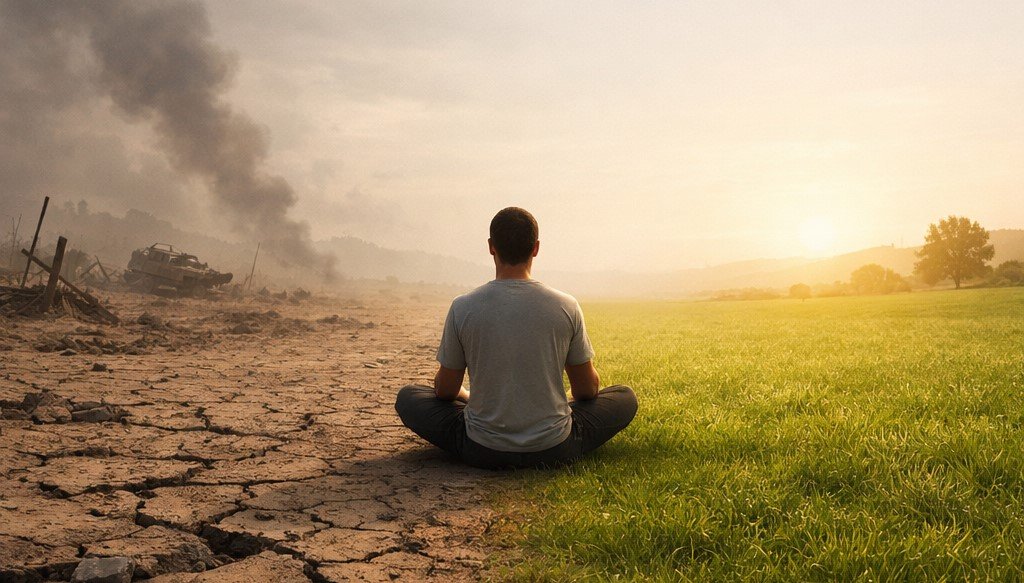
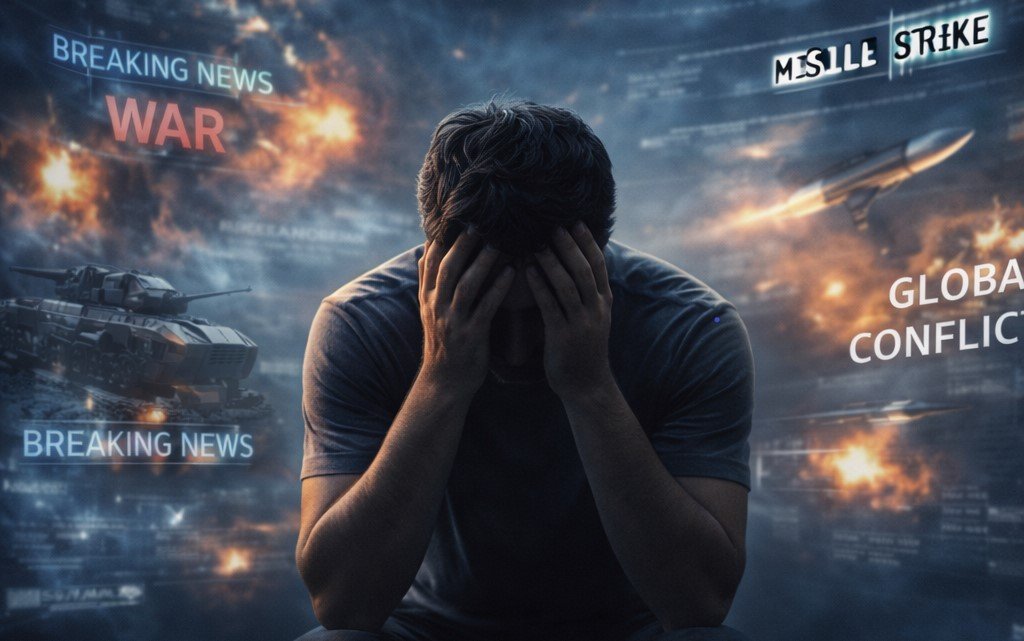
Ceasefire talks. Airstrikes. Refugee crises. Casualty numbers scrolling across your screen. Even if the conflict is thousands of miles away, your body responds as if the danger is right outside your door.
This isn't weakness  it's biology. And understanding exactly how news about global conflict affects your physical and mental health is the first step toward protecting yourself and your family.
The Science: What Happens to Your Body When You Watch Conflict News
Your brain cannot fully distinguish between a threat you see and a threat you experience. Research from the American Psychological Association's Stress in America report confirms that news consumption is a significant source of stress for the majority of adults. When you watch footage of bombings, read about civilian casualties, or follow ceasefire negotiations that keep failing, your nervous system responds with a real, measurable stress reaction:
The Stress Cascade
- Your amygdala sounds the alarm  it detects threat in the images and words you consume
- Cortisol and adrenaline flood your bloodstream  your heart rate increases, muscles tense, breathing becomes shallow
- Your prefrontal cortex goes offline  rational thinking, planning, and emotional regulation become harder
- Your immune system dials down  your body diverts energy from healing to "survival mode"
- The cycle repeats  you check the news again, and the cascade starts over
One or two stress responses are manageable. But when this cycle repeats dozens of times a day, every day, for weeks or months, the damage accumulates silently.
How Conflict News Damages Your Physical Health
The connection between news stress and physical illness is stronger than most people realize. Here's what research tells us:
Cardiovascular Impact
A landmark study published in the Proceedings of the National Academy of Sciences following the September 11 attacks found that people who watched 4+ hours of daily news coverage had a 53% increased risk of cardiovascular problems over the following three years  even if they lived nowhere near the event. During ongoing global conflicts, the effect is similar: chronic news stress keeps blood pressure elevated, increases heart rate variability, and promotes arterial inflammation.
Immune System Suppression
Chronic cortisol exposure from sustained news stress weakens your immune response. You may notice you're catching colds more often, healing slower from minor injuries, or feeling generally run down. This isn't a coincidence  your body is literally prioritizing "threat response" over "repair mode."
Digestive Problems
Your gut has its own nervous system  the enteric nervous system  which is directly connected to your brain. During periods of prolonged news stress, many people experience:
- Stomach cramps and nausea
- Loss of appetite or stress eating
- IBS flare-ups
- Acid reflux and bloating
Chronic Pain and Tension
Sustained stress keeps your muscles in a constant state of tension. This commonly manifests as:
- Tension headaches and migraines
- Neck and shoulder pain
- Jaw clenching (bruxism)  especially at night
- Lower back pain with no clear physical cause
Sleep Disruption
Perhaps the most damaging effect: conflict news destroys sleep quality. Your brain replays disturbing images during the night, cortisol levels stay elevated when they should be dropping, and you may wake up feeling exhausted even after 7-8 hours in bed. Poor sleep then amplifies every other health problem on this list.
The Mental Health Toll: Beyond "Just Feeling Sad"
The psychological impact of sustained conflict news goes far deeper than temporary sadness. Mental health professionals are seeing a surge in specific conditions directly linked to news consumption during global crises:
Secondary Traumatic Stress (STS)
Originally identified in healthcare workers and first responders, STS now affects millions of ordinary news consumers. According to the National Institute of Mental Health, symptoms mirror actual PTSD:
- Intrusive thoughts and mental replays of disturbing images
- Hypervigilance  constantly scanning for threats
- Emotional numbness and detachment
- Avoidance of anything that reminds you of the conflict
- Difficulty feeling safe even in secure environments
Anxiety and Panic Attacks
The uncertainty of global conflict  will there be a ceasefire? Will it escalate?  creates a specific type of anxiety called intolerance of uncertainty. Your brain craves resolution, so you keep checking the news for answers that never come, creating an endless loop of anxiety and checking.
Helplessness and Depression
Watching suffering you cannot stop creates a profound sense of learned helplessness. Over time, this generalizes beyond the news: you start feeling powerless in your own life, less motivated at work, less engaged with family, and less hopeful about the future.
Guilt and Moral Injury
Many people experience intense guilt for:
- Being safe while others suffer
- Feeling happy during a global crisis
- Looking away from the news to protect themselves
- Not doing "enough" to help
This guilt is a form of moral injury  a deep conflict between your values (wanting to help) and your reality (feeling unable to). It can be as damaging as direct trauma if left unaddressed.
Who Is Most Vulnerable?
While news stress affects everyone, certain groups are particularly at risk:
- Parents  the added layer of worrying about your children's safety and future amplifies stress exponentially
- People with existing anxiety or depression  conflict news acts as a powerful trigger
- Empathetic individuals  high empathy means your mirror neuron system processes others' pain more intensely
- Those with personal connections to conflict zones  family, cultural ties, or religious connections deepen the emotional impact
- People who live alone  without social buffers, news stress hits harder and lingers longer
- Night-shift workers and insomnia sufferers  late-night doom scrolling compounds existing sleep problems
The Doom Scrolling Addiction: Why You Can't Stop
If you've ever told yourself "I'll just check one more update" and then lost 45 minutes, you're experiencing a well-documented psychological trap:
- Uncertainty drives seeking behavior  your brain releases dopamine when searching for information, even negative information
- Intermittent reinforcement  occasionally you find a hopeful update (ceasefire progress, rescue stories), which rewards the scrolling and keeps you coming back
- Negativity bias  your brain is wired to pay more attention to threats than safety signals, making negative news literally harder to look away from
- Social pressure  you feel you "should" stay informed, that looking away is irresponsible
Understanding this mechanism is crucial: you're not weak for doom scrolling. Your brain is doing exactly what evolution designed it to do  monitoring threats. The problem is that your threat-detection system was built for a world where threats were local and temporary, not global and 24/7.
10 Evidence-Based Ways to Protect Your Health During Global Conflict
1. Implement the "Inform, Don't Immerse" Rule
There's a critical difference between being informed and being immersed. You need to know what's happening in the world. You do not need live footage on a loop, real-time casualty updates, or comment section debates.
Action: Choose one trusted news source. Read a summary once or twice daily. Then close it.
2. Set a Hard News Curfew
No news consumption within 2 hours of bedtime. This gives your cortisol levels time to drop and your brain time to shift out of threat-monitoring mode before sleep.
Action: Set an alarm on your phone labeled "News Curfew" and honor it like a bedtime.
3. Move Your Body Within 10 Minutes of Stressful News
When cortisol and adrenaline flood your body, they're preparing you for physical action. If you don't move, those chemicals stay circulating and cause damage. Even a 10-minute walk, stretching session, or dancing to one song helps metabolize stress hormones.
Action: After reading news, immediately do something physical  even if it's just walking to the kitchen and back.
4. Practice "Containment" Journaling
When distressing thoughts from the news circle in your mind, write them down in a specific notebook  your "containment journal." The act of writing externalizes the worry, and closing the journal creates a psychological boundary.
Action: Write for 5-10 minutes. End with one thing you're grateful for. Close the journal. The worries are "contained" there now.
5. Use Bilateral Stimulation
A technique from EMDR therapy: alternating left-right stimulation helps your brain process distressing information. You can do this simply by:
- Going for a walk (left-right foot movement)
- Tapping alternately on your left and right knees
- Moving your eyes slowly from left to right and back
Do this for 2-3 minutes after consuming upsetting news.
6. Create Social Support Rituals
Isolation amplifies news stress. Talking about how you feel  not debating politics, but sharing emotions  activates your social bonding system and releases oxytocin, which directly counteracts cortisol.
Action: Schedule a weekly check-in with a friend or partner: "How are you really feeling about everything going on?"
7. Feed Your Body for Stress Resilience
During chronic stress, your body burns through certain nutrients faster. Support your stress response with:
- Magnesium  depleted rapidly under stress, crucial for calm (see our magnesium guide)
- Omega-3 fatty acids  reduce inflammation caused by chronic stress
- B vitamins  support nervous system function
- Vitamin C  helps regulate cortisol production
- Probiotics  protect the gut-brain axis under stress
Avoid excess sugar, alcohol, and caffeine  they all amplify the stress response.
8. Practice "Compassionate Witnessing" Instead of Doom Scrolling
You can care deeply without consuming destructively. Compassionate witnessing means:
- Acknowledging the suffering without repeatedly exposing yourself to graphic content
- Taking one meaningful action (donating, volunteering, writing to a representative)
- Then releasing the guilt and giving yourself permission to live your life
One act of compassion does more than a hundred hours of scrolling.
9. Protect Your Children's Exposure
Children process conflict news differently than adults. Their developing brains lack the context to understand scale, distance, and probability. A war on the other side of the world can feel like it's happening outside their window.
- Never have graphic news playing in the background when children are present
- If they ask questions, answer simply and honestly: "Some people are fighting far away. Many others are working to stop it."
- Focus on helpers: "Look at all the people trying to make peace"
- Maintain routines  predictability is the antidote to anxiety for children
10. Know When to Seek Professional Help
If you experience any of the following for more than two weeks, consider speaking with a mental health professional:
- Inability to function at work or home
- Persistent nightmares or flashbacks from news images
- Panic attacks triggered by news alerts
- Complete emotional numbness or inability to feel joy
- Using alcohol or substances to cope with news anxiety
- Thoughts of self-harm or hopelessness
There is no shame in seeking help. Therapists trained in trauma can provide specific tools like EMDR, CBT, and somatic experiencing that are highly effective for news-related stress. You can find a licensed therapist through Psychology Today's directory or the BetterHelp online therapy platform.
A Weekly Self-Check: How Is the News Affecting Me?
Use this simple check-in every Sunday evening to monitor your relationship with news:
| Question | Green (Healthy) | Red (Take Action) |
|---|---|---|
| Sleep | Falling asleep within 20 min, feeling rested | Lying awake replaying news, waking exhausted |
| Mood | Moments of joy and calm throughout the day | Persistent dread, sadness, or numbness |
| Body | Normal appetite, no unexplained pain | Headaches, stomach issues, tension, appetite changes |
| Focus | Able to work and engage with family | Can't concentrate, constantly checking phone |
| Relationships | Connecting normally with loved ones | Withdrawing, snapping, or arguing more |
| Screen time | Under 30 min of news daily | Over an hour, or checking compulsively |
If you have 3 or more red answers, it's time to take immediate action: reduce news consumption, prioritize sleep, move your body, and talk to someone you trust.
The bottom line: Caring about the world is a sign of your humanity. But sacrificing your health to the news cycle helps no one  not the people suffering in conflict zones, not your family, and certainly not you. Staying informed is responsible. Staying immersed is destructive.
You have permission to step away. You have permission to feel joy even when the world is hurting. You have permission to protect your peace so that you can show up  stronger, calmer, and more capable  for the people who need you.
Looking for practical steps to start your mental recovery? Read our guide on declaring a ceasefire for your mind or explore 12 proven methods to reduce stress naturally at home. You can also take our Stress Level Quiz to understand where you stand right now.
Frequently Asked Questions
Yes. Research from the American Psychological Association shows that constant news consumption raises cortisol, increases blood pressure, weakens immune function, and can trigger headaches, digestive issues, and chest tightness. Chronic news stress has been linked to a higher risk of cardiovascular problems.
Secondary traumatic stress (STS) occurs when you experience trauma symptoms  anxiety, nightmares, hypervigilance, emotional numbness  from witnessing others' suffering through media rather than direct experience. It is especially common during wars, natural disasters, and humanitarian crises.
Mental health experts recommend limiting news consumption to no more than 30 minutes per day, ideally split into two short sessions. Checking news once in the morning and once in the evening, with strict time limits, helps you stay informed without overwhelming your nervous system.
This is called moral witnessing guilt  the belief that looking away means you don't care. In reality, protecting your mental health makes you more capable of empathy and action. A burnt-out person helps no one. Setting boundaries is responsible, not selfish.
Children lack the emotional tools to process graphic conflict coverage. Exposure can cause nightmares, regression in behavior, clinginess, anxiety, and a distorted view of the world as purely dangerous. Experts recommend shielding children from graphic news and having age-appropriate conversations instead.
Absolutely. Doom scrolling keeps your body in a prolonged stress state, which raises blood pressure, suppresses immune function, causes muscle tension, disrupts digestion, and interferes with sleep quality. Over time, this chronic activation contributes to inflammation and increased disease risk.